Labels

Showing posts with label trends. Show all posts

Monday, May 26, 2025

Over, Under, Appropriately Hyped: Postpartum Edition


I gave up TikTok for Lent and haven't been back, but last time I was in the world of BookTok there was a trend of holding up a book and simply saying whether you thought it was under-hyped, over-hyped, or appropriately hyped. I've been thinking about that a lot in terms of postpartum experiences, so let's play Under-, Over-, or Appropriately Hyped: Postpartum Edition.

Breastfeeding, General: Appropriately Hyped
People said that breastfeeding was really challenging, but magical. I would concur...although it is way more challenging than I could have imagined. My friend Caitlyn told me that she read a study saying that a week of breastfeeding is the energy equivalent of working a sixty-hour work week.


Breastfeeding, Nipple Pain: Under-Hyped
People said that your nipples could get sore at first, but no one told me that for days I'd literally be biting a rolled up rag like a Civil War soldier having surgery without anesthesia every time Elle latched.

First Postpartum Poop: Over-Hyped
Everyone made this out to be terrifying, but in my case, it was not. I think it's probably because I only had a first degree tear, I took all the stool softeners offered me, I elevated my feet when I went, and I had braced myself for the experience to be an ordeal.

Sleeplessness: Appropriately Hyped
People say the lack of sleep is bad, and...it is XD There was one night that I was staring at the clock and I couldn't even get my eyes to focus. It was 44:4444 o'lock. Fortunately Gabe is a one-in-a-million partner and takes the first night shift (like 10pm–2am) all by himself so that I can get sleep at least at the beginning.

Postpartum Peeing: Under-Hyped
The first postpartum poop is discussed a lot, but why are y'all not talking how it BURNS TO PEE every time, even three weeks in?! This is way worse than pooping. Yeah, I tried the peri bottle trick of spraying while you pee, and IT STILL HURTS. The only time it doesn't hurt is if I pee in the shower, so...there's that lovely little tip for anyone currently pregnant.

Breastfeeding Hunger: Over-Hyped
I have a theory about why I haven't experienced the notorious ravenousness that comes with breastfeeding: I've been stuffing my face every since I got back from the hospital XD I don't think I've even given myself a shot at being ravenous.

Postpartum Hormones: Under-to-Appropriately Hyped
I was told that I would cry a lot and that there would be moments where I would loathe my husband. Days 6–10 were the most emotional for me (might do a post on all the things that made me cry during that span ðŸ˜‚), but I haven't LOATHED Gabe yet. There have been a handful of times when I was really annoyed at him, but I was able to acknowledge that they were hormonal feelings and didn't make real sense.

First Postpartum Nap: Under-Hyped
We came home with Elle on a Wednesday night, "slept" that night, and Mom came over the next day to help us settle. That afternoon, I took a two-hour nap.

Oh. My. Gosh.

When Gabe woke me up because Elle needed to nurse...for the first five seconds, I had no identity. I had been called back from a region of such deep Nothingness that I genuinely could not have told you my own name or species. It was like being raised from the actual dead. I've never slept that deeply in my life, and probably never will again.

Secret Moms' Club: Under-Hyped
Ever since I had Elle, mom friends have been checking in on me and encouraging me and it's been the most beautiful and humbling thing. I had no idea that all these women my age were in the trenches together and that having a baby would initiate me into such a special pocket of my village. Y'all are such a bright light in what can sometimes be a dark and lonely season.

I would say that overall, postpartum comes out to be appropriately hyped...but also under-hyped. And it's no one's fault, I just didn't understand what people were telling me. It's kind of like marriage: everyone tells you that it's really hard, and you're like, "Okay, got it, I hear you, it's really hard," but then you DO it and you're like, "Oh JEEZUS, it's like HARD hard, in ways I didn't even have categories for before."

Since everyone was right about postpartum and the newborn stage being tough, I will hold out hope that they're also right in that it doesn't last forever, and that it will be worth it ;)

~Stephanie

Sunday, January 8, 2023

The YA Author Who Hates YA?


I'm confused.


This is about to be one of those posts where I'm not sure what I need to say, so I ramble until we figure it out together.


Sort of like the exact opposite of a good essay. Or a good novel.


Some of y'all know I'm trying to write a young adult fantasy novel. One of my editors, Chersti, reminded me that the best continuing education I can do is read current YA fantasy novels: see what's out there, what young adults are enjoying, how the characters and stories feel.


In the spring of 2021, I read An Ember in the Ashes and The Wicked Prince. I didn't particularly enjoy either (though I liked Wicked Prince more), for several reasons:

1) I read them quickly, mostly "to have read them," rather than to enjoy them. (I've recently learned that that's a very ENFJ thing to do.)

2) I was haunted by the fear that they'd somehow invalidate the Fire Faery Story, that they'd be too similar, or much better.

3) They were written in present tense, which I hate.

4) The characters and stories felt thin and pale.

5) I felt like I was too close to the book-writing process to enjoy them as literature, like a freshly graduated magician watching someone do tricks at a kid's birthday party. I saw all the fishing line hanging from the authors' props, all the ways they'd choreographed situations to tell the reader what the characters looked like, how old they were, what different world-building terms meant, what the characters' "story goals" were. Everything felt clumsy and contrived.


This weekend, I started reading The Stardust Thief. It is blessedly past tense, but that's my favorite thing about it so far. I'm still nearly paralyzed by the fear that something about this book will hurt the process of my own novel. I still see fishing line everywhere.


And what's worse is that the author is doing tons of things that I did or wanted to do in the Fire Faery Story, but was told "you can't do that" (e.g., italicized flashbacks in the middle of a chapter). It makes me angry and indignant. If this author can break "the rules," why can't I? Why was I hamstrung into writing something that felt forced and soulless when CLEARLY doing what I wanted to do would not have been the authorial suicide I was led to believe? I may be flattering myself, but I do not think Abdullah is doing it significantly "better" than I was.


As far as I can tell, reading current YA isn't working for me. I hate it. I hate the process, I hate the stories, I hate the characters, I hate the conflicts. (At least part of this isn't YA's fault; my current state of mind is partly to blame.) I hate that current YA feels different from the YA I knew and loved as a kid. What's changed? Is it really me, or are "kids these days" wanting something different than what I grew up reading?


I decided that maybe it would be better to reread some YA that I loved as a teenager. I Googled "YA fantasy books 2007–2014" and started skimming some titles. I remembered a lot of them. And you know what feeling welled up in me as I read probably 80% the titles I recognized?


Disdain.


WHAT?!


YA fantasy was my drug of CHOICE back in the day. YA fantasy is THE ONLY type of story I have ever wanted to write, or ever tried to write.


And yet, if memory is serving me as I scroll through titles, I disliked the majority of YA fantasy even as a young adult myself (looking at you, Wicked Lovely, Divergent, Maximum Ride, Dark Angel, Across the Universe, etc.)


I tried to think of the YA fantasy books that I remember loving: Inkheart, the Mortal Instruments trilogy, the Twilight saga (yes, I would be happy to have a conversation about that with you, thanks for asking), the Hunger Games trilogy, the Inheritance cycle (ONLY the first two) the Uglies series, the Farsala trilogy.


But like...that's it. Those are IT. Those are the sum total of the YA fantasy books that evoke good feelings off the top of my head.


That...is not a lot of books. That doesn't feel like a wide enough sample for me to have branded myself as a lover of YA fantasy for MY ENTIRE LIFE.


What does this mean?!


I just glanced over at my bookshelves and saw non-YA fantasy titles that I loved as a teenager: Homeless Bird, Angel on the Square, Homecoming, The Thief Lord, From the Mixed Up Files of Mrs. Basil E. Frankweiler, On to Oregon. Very few of those conform to the "rules" I'm told I need to follow if I'm going to be successful as a YA writer. In fact, by today's standards, many of those probably wouldn't fit into the YA genre at all.


So I'm left with lots of overwhelming questions, in no particular order:


1) Did I actually love "YA fantasy" as a kid, or did I just like well-written books?

2) Are kids these days THAT fundamentally different from kids who were fourteen in 2008?

3) If I follow my gut/heart and write the way I want, will my story actually flop, or will it just appeal to a narrower slice of the demographic (which might be the same thing to publishers)?


I'm so confused. I'm confused about what made me like certain books as a teen, and what to do with all these modern rules and standards and exceptions that make a YA fantasy book marketable. If Chelsea Abdullah can splice loosely-related italicized flashbacks into the middle of chapters in The Stardust Thief (published 2022), why the hell can't I? And if Angel on the Square (published 2001) had a time skip of four years, can I really not have a one-year time skip in my book?


I know writing books is both an art and a science, but I'm having trouble knowing when to break the rules and when to keep them. When is it wise to be the artist, and when is it wise to the the scientist?


I also know that this is probably what all first-time aspiring authors go through. I know this is what good editors will help me navigate. I know life is full of calculated risks. I know there's no way to know what will work until I just do it.


But it's really frustrating and confusing. I can do hard things, but this isn't just a hard thing, it's a...I don't even know what it is. I think that's what makes it so hard. It's not like trying to do a maze in the dark, it's like walking around in the dark not knowing if it's a maze, or someone's house, or the middle of a forest, or a different planet, or if everyone else has night vision, or if you're actually dead or—


It's just a lot.

~Stephanie


Sunday, October 3, 2021

Do You Want to Be Comfortable or Do You Want to Be Happy?


It occurred to me the other day that I've gotten out of practice doing things I don't want to do.

{Aaaaaaand from here, this post went in a direction I didn't see coming, which happens to me a lot. I really thought this would be a short post, and yet here I am, adding this note thirty minutes into writing it. I think some of the post is going to seem anti-mental health. I don't think I am. If you want to talk about it, I'd love for you to message me.}

As a kid you often have to do things you don't want to do. Your parents make you do chores before you can hang out with your friends or watch TV. Then, if you go to college, you have more things to do that you don't want to do—even if you like your major. Your professors make you turn in papers and drafts, show up to classes, read books and plays and articles, and books and articles about books and plays.

In today's society (all of my English professors just died inside), we seem to be glorifying comfort more and more. "Glorifying" might not even be strong enough; "idolizing" might be more accurate.

If someone is "stealing your peace," cut her out of your life. You don't need that kind of negativity.

If you suddenly don't feel like doing something you RSVP'd to, don't go. You don't owe anybody anything.

If you've had a rough week, you should just watch Netflix and scroll on your phone for hours. You deserve a break.

There are all these movements to "normalize" things too—AKA force people to accept things because the idea of their not accepting them makes you uncomfortable.

Normalize women having body hair. Or how about if you're a woman, you do what you want with your body hair and don't care what other people think?

Normalize men showing emotions. Or maybe if you're a man, show emotion as much as you want and don't care what other people think?

Normalize eating at restaurants alone. Or maybe if you want to eat at a restaurant alone, just do it.

Things don't have to be "normalized" for you to do them. It isn't as though these things aren't allowed; people are just too chicken and uncomfortable to do things until society accepts them. It isn't everyone else's job to make sure you feel "normal."

(Do people even want to be "normal"? Isn't it more fun to stand out?)

If you don't feel like cooking, you can have food delivered to your door.

If you don't feel like shopping, you can buy anything online and have it shipped to you.

If you don't like cleaning, maybe you hire some help.

Now, on one hand, I get all of these things. Mental health and boundaries are important.

If someone is stealing your peace, it may be a healthy thing to get some distance. But it might also be healthy to have an uncomfortable conversation with the person.

If you are running yourself ragged and need a break, you might be right to sit out a social event that you RSVP'd do. However, my gut says that commitments to other people are important. It's not all about you. You don't get to let people down just because you're feeling tired. You should've thought of that before you RSVP'd, or planned your week better since you knew this event was coming up.

Sometimes turning your brain off to watch TV or scroll social media might work, but maybe spending time in prayer, taking a walk, or journaling—things that are less comfortable, but may do more to heal you—are a better option.

I get it: no one wants to be labeled rudely for their body hair, being emotional, or eating alone. Yes, if all these things were "normalized" you'd be more comfortable with yourself.

But you might also be lazier and less brave.

I've been living as an adult for a few years now. It has been a really long time since someone has made me do something. I spend a good amount of time on Facebook and Instagram, where trends and Society run rampant. I think the message of King (or Queen, if you'd like) Comfort have slowly sunk into my subconscious.

Why should I clean my apartment? I don't want to.

Why should I grade these papers? I don't want to.

Why should I read this book for work? I don't want to.

Why should I go to the grocery store? I don't want to.

Gradually, it has gotten harder and harder to make myself do these things.

I just won't clean. We rarely have guests. Who cares? No one is going to make me.

I just won't grade these papers. I'll do it next week. Maybe.

I just won't read this book. I'll read it tomorrow. Or the SparkNotes. Or watch the movie.

I just won't go to the grocery store. I'll get things delivered or ask Gabe to stop on the way home from work.

All these are viable options, and what's more, I've allowed myself to be conditioned by Society into thinking I deserve to take these shortcuts. I deserve to be comfortable. I deserve to be happy.

Ooh, that's it. Society has decided that comfort equals happiness, and we all deserve to be happy.

Well, I don't think I'm happy. I think this has been a huge bait-and-switch. I took a bite of happiness and it turned to discontentment inside my mouth.

I don't like the "comfortable" person I've become.

At Classical Conversations, one of the things we want students to learn is "how to do hard things." You don't like Latin? It's hard for you? Good. You're going to have to do difficult things you don't like your whole life. This isn't about a subject, it's about your character. Learn to do hard things.

I've gotten out of the habit doing hard things. I've begun to believe the lie that comfort will make me happy. I don't think comfort will make me happy. I think doing hard things will make me happy. I think cleaning my apartment even when I don't want to will make me a better person. The goal is not even to get to a place where I want clean my apartment. I should clean my apartment in the midst of the not wanting to.

No one makes me do things I don't want to do anymore. Not my parents, not my professors, not my boss(es), not my husband. I am the only one who will make myself do hard things, and for a while now, I often haven't.

Yesterday, when these thoughts began forming in my mind, I decided that I would do one thing a day that I didn't want to do. Yesterday it was cleaning the apartment.

It was weird, because I really didn't want to. It was like I thought if I made it a game, a challenge—"Today cleaning the apartment will be the thing I do even though I don't want to"—it wouldn't suck as much. But I found that it still did. I almost didn't do it, because I REALLY still didn't want to. But I did do it. I was really glad that I had. (And I was REALLY glad today that I had.)

Today I didn't want to assess some formal logic midterms that students took last week. I didn't have to. I have time to do it other days. But I did. I really didn't want to, but I did. It was easier than cleaning the apartment. I feel really good having done some of them.

I know a lot of things I don't want to do tomorrow, but I'm going to pick one—one I really don't want to do—and I'm going to do it.

Mental health is important. But that's not why I wasn't cleaning the apartment. I wasn't cleaning the apartment because the sacrificial part of my character was growing weak.

And I don't want to live like that. It doesn't make me happy.

~Stephanie

Monday, October 28, 2019

"That Hurt My Feelings": Part 2


For context and part one, I would highly recommend reading "'That Hurt My Feelings' Part 1." If you don't have time for that, here's what happened in a nutshell: This podcast about songs written for the Enneagram types blew my mind with the revelation that my whole life I've just been "open" when I thought I was being "vulnerable."

I'm an Enneagram type Eight: passionate, assertive, dedicated to justice, and terrified of betrayal. The second podcast quote/concept that brought me up short was this:

2) "This word 'vulnerability' comes from the Latin word for 'wound,' and to be vulnerable means to be 'wound-able'..."

Somewhere in the podcast—or maybe it's just implied, because I can't find it right now—Chris talks about how difficult it is for Eights to confess when they've been hurt, to say the words, "Hey, that hurt my feelings."

My actual reaction:


Wait, I thought, feeling slightly panicked. Do other people actually TELL PEOPLE when they've been hurt?! Do other people say, "Hey, that hurt my feelings?!" Past the age of, like, five?

I don't do that. I do NOT do that. The concept is foreign, uncomfortable, and slightly ridiculous to me. Why would someone do that? Why would you walk up to the Indians* and say, "Hey, here are some guns, and by the way I don't wear armor on my back."

I vividly remember the handful of times people have come to me and said, "Hey, when you did X, it really hurt my feelings."

I feel like they've just pulled their pants down in the middle of the mall. I feel like asking them if they know they said that out loud. I feel like they've just handed me an endangered aquatic animal and I'm holding it, dripping, out in the air, afraid it might die at any second but, like, there's not an ocean around, so what am I supposed to do with it?

To my memory, I have only ever told one person that he hurt my feelings, and it was Gabe, and it was in the past six months, and I remember it feeling really, really weird.

[I feel like I need to add that I genuinely don't get hurt very often. It is very hard to offend me personally. I was an English major, and we basically major in putting ourselves out there and having someone (constructively) criticize us. I am all about "breaking bones til they're better." But...apparently this isn't because I'm good at being vulnerable; it's because my collection of vulnerabilities is guarded deeper and better than most.]

Yesterday at regular small group, the concept of vulnerability came up AGAIN, and that coupled with the Sleeping At Last podcast had Gabe, Cassidy, and me talking about this revelation on the way home.

I told them about my revelation of openness versus vulnerability, and told them that I wanted to work on this, but that I didn't know how. I've always thought I was being vulnerable, but it turns out I've just been open. So what IS vulnerability, and how do I do it?

They said some things, and gave examples, but I was all like, "Yeah, I don't mind sharing that at all. That must not be vulnerable for me?"

Gabe suggested, "It would be like—and this is just a really concrete example—going up to someone and saying, 'Hey, here are some things that would make me really sad or really bother me. Just so you know.'"

"Okay..." I said slowly, fighting back the inner screams of WHY WOULD SOMEONE EVER DO THAT?

"It would be things you don't want people to know," Cassidy said. "Like weaknesses or fears."

"Okay..." Some very specific thoughts and ideas came to mind. "Okay, I'm starting to get some. And...maybe I'm not ready to vulnerable because I definitely don't want to say them."

As a Four and a Nine, they didn't push.

This post does not end in my being vulnerable. Not today. Today you just get some more openness. But I'm aware of the difference now, and I'm beginning to approach it.

Actually, here's something that feels a little vulnerable, because I have not wanted to tell you: If you want to know me on a level I'm not entirely comfortable sharing, I'd suggest listening to the Sleeping At Last podcast on the song "Eight."

~Stephanie

* Don't come at me with the PC police. I'm just going off the idiom of "selling guns to the Indians."

Monday, October 21, 2019

"That Hurt My Feelings": Part 1


I'm gonna need you to stick with me through this one. It's going somewhere—honest—and I already split it in half from what it was originally, so you're welcome.

The Enneagram* has really taken off in my life and the lives of those closest to me. We have been having revelations left and right, unlike anything I've ever experienced. If you know me, you know that my entire life has been a quest for personal revelations and indications of how to grow better, almost (definitely? See below.) to the point of being obnoxious.

[Tangental Story: When I was 12 or 13 years old, I had three best friends: my sister Sarah, Jesse, and Ellie. We were close for lots of reasons (one of them being The Fire Fairy Story, which soon may have a hyperlink, because I think it's creeping back into my Becoming journey). Lately we'd been having issues of the typical petty, hormonal type, and I was done with it. I literally SAT US ALL DOWN and made everyone go around in a circle and tell something that bothered them about all the other people. My intention was to get everything out in the open so that we could deal with it, grow, and become stronger friends. However, this is when I learned that not everyone jives with this sort of confrontation. Everyone ended up mad at each other, no one wanted to work through things, and they still give me a good-natured hard time about "Stephanie's bashing circle" to this day XD]

Okay, wow, that really was a tangent. I'm supposed to be talking about being vulnerable. Maybe I'm stalling? Or maybe there's just so much context needed to do this subject justice.

I'm an Enneagram type Eight. Eights are passionate, assertive, dedicated to justice, and terrified of betrayal.

Since I last wrote about the Enneagram, I've been introduced to the "band" (it's just one guy, kind of like Owl City) Sleeping At Last and his Enneagram project (thanks, Garrett!). This man, Ryan, did months of intense research about each Enneagram type and wrote a song for each. Because every facet of each song is engineered to reflect its Enneagram type, he also has a podcast where he unpacks the elements of each song, from the lyrics, to the tempo, to the instruments, to the random "fingerprint" sounds buried in the music.


Throughout this commentary, an Enneagram expert named Chris has segments where he unpacks each type a little bit. Gabe and I listened to the podcast on his type (Four) and my type (Eight) in the car last weekend. There was a lot of blushing and side-eyeing each other when the nail was hit so squarely on the head we felt it almost physically. [Cassidy has since started listening to the podcast on her type (Nine) and is, and I quote, "shook."]

A LOT (most? all?) of the things said about Eights resonated with me, but one concept stuck out above all the rest. It can be broken into two quotes from the podcast, one of which I'm covering in this post:

1) "For [an Eight], the first lesson, and maybe the hardest lesson, is this movement from transparency to vulnerability."

I heard this podcast three days after my ladies' small group leader, Lindsay, had dropped a bomb that she probably didn't even see land on me:

"I'm very good at being open," she said in passing. "But I'm not good at being vulnerable."

If I'd been mentally walking along, this stopped me in my tracks.

Wait, those are DIFFERENT?! I screamed in my head.

My whole life, I've assumed I was great at being vulnerable. I've assumed vulnerability was something I didn't struggle with at all. I am perfectly comfortable talking about things that make most people squirm. If you ask me, I'll tell you intimate details about literally anything. This blog (and all the others I've had throughout the years) is full of my being what I thought was "vulnerable," but turns out is just "open" or "transparent."


Then I got to thinking: if all I've ever done is be open, do I even know how to be vulnerable?

And the answer, I think, is "no." Or, better, "not yet."

In Part 2, I'm digging into the conversation with Gabe and Cassidy that followed this self-revelation, and the second quote from the podcast that mentally stopped me in my tracks.

~Stephanie

* If you want to find out your Enneagram type, YOU MUST READ (at least a little) ABOUT ALL NINE TYPES AND FIGURE IT OUT FOR YOURSELF. Internet quizzes WILL NOT tell you your type. I have actually removed the hyperlink to an internet quiz in my original Enneagram post because it proved so ineffective at helping my friends, family, and self identify our types.

Thursday, October 3, 2019

The Enneagram


To be honest, I don't want to say too much on this, for a couple of reasons.

1) While I've done some research and reading, I'm not educated enough to give you the insight I think everyone should have.

2) If I allowed myself, this post could easily become too long.

What is the enneagram?
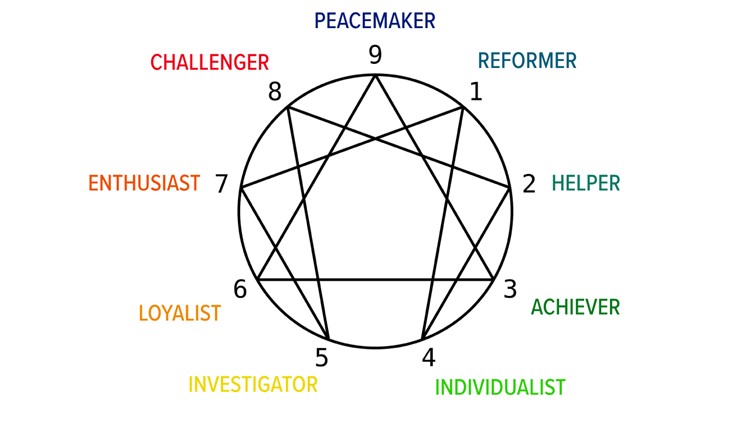
It's a nine-pointed shape. It's an ancient (think "B.C.") theory that there are nine basic personality types that relate to each other in a specific pattern. It has been used and proven for thousands of years. It has been used and proven in the lives of many people I know, including mine and Gabe's—and Gabe is an avid hater of personality tests and theories (he's a self-diagnosed Four).

"Enneagram." Isn't that Satanic?
1) Lots of strong Christians use this.
2) Possibly lots of strong Satanists use it too; I don't know any personally.
3) While it definitely sounds suspect, the enneagram is just a descriptive tool for understanding yourself and others. It does not claim to have any magical powers or ask you to do anything with its information. I'm sure it can be taken to an extreme or held up as an idol, but I'm not sure how the information itself could be Satanic or dangerous.

It also doesn't have to be in a shape. You can write the information down in list-form if it makes you feel better.

If I come across a little aggressive and passionate here, bear with me. I've learned that I'm probably an Eight.

Could you stop saying numbers and tell me how this works?
There are nine different personality types. You are one of them. Each person might also have a "wing," which is one of the numbers on either side of the person's main number. I've said that I'm Eight, and I think I might have a Seven wing. This means that while I'm mostly Eight, sometimes I have characteristics of a Seven.

Each personality type has a "stress" and a "security" number as well. When Eights are feeling stressed, they tend to take on the negative characteristics of a Two. When Eights are feeling secure, they tend to take on the positive characteristics of a Five.

All this info is more easily grasped in the dreaded, Satanic-looking enneagram shape (different people have different titles for the types):


How do I find out my type?
If you're interested, there are internet quizzes to help you figure out which number you might be. However, my dad (yes, the Baptist pastor) recommended that I read books on the topic so that I can understand the numbers and figure myself out, rather than have an algorithm tell me what I am.

So far I've used The Road Back to You: An Enneagram Journey to Self-Discovery* by Ian Cron and Suzanne Stabile, and The Enneagram: A Christian Perspective by Richard Rohr and Andreas Ebert. I've also listened to the podcast for The Road Back to You.

How does it help?
At the end of each Type's chapter in The Road Back to You, there is a short list of suggestions for how that type can grow. Two of the suggestions for me were "Watch out for and avoid black-and-white thinking. Gray is an actual color" and "You don't have a corner on the truth market. In the heat of battle, stop and ask yourself, What if I'm wrong? Say that a hundred times a day."

Spot. On. Advice XD

After doing some reading himself, Gabe believes he's a Four. Knowing that, I can read about the way Fours think (or, more accurately, "feel") and love him better.

Identifying our types has already affected our marriage positively. Gabe understands better that my knee-jerk reactions sound like anger, even when I'm not actually angry, and that I push just to see who will push back. I understand better that he doesn't "have" feelings, but more is feelings, and when he doesn't explain himself, it isn't just because he won't, but often because he can't.

Who cares?
Maybe not you, and that's okay. In my very-newly-formed opinion, the enneagram is most helpful for understanding yourself: how you've been coming across your whole life, where your weak or blind spots are, and how you can grow to be the you that God created you to be.

I do not think it's a tool for putting people into boxes or giving yourself an honorary degree in psychology. While I enjoyed wondering about the Types of people in my life, I don't think I can tell them what their number is. You can watch someone's eating habits and make an educated guess about their favorite foods, but if someone replies, "Actually, brownies aren't my favorite," you have no right to retort, "Yeah they are. I read a book about food."

Only you can decide and own your number. You'll probably know it when you reach a Type description that makes you wince.

~Stephanie

* This book does lean left, mainly just in some of its anecdotes. I'm a conservative and was able to look past that, but be aware of that going in. Don't let two authors' political opinions turn you off from the enneagram.

Monday, August 26, 2019

Two Years Late to the Podcast Party


A couple of years ago, podcasts became trendy. People would ask me if I listened to podcasts, and I would tell them that I did not. They would recommend podcasts and I would repeat that I didn't listen to podcasts. I didn't see the hype. I'm pretty picky, and I couldn't be bothered to find podcasts that I liked.

I had, however, developed enough self-awareness to know that eventually, I would absolutely succumb to the hype, it just hadn't hit me yet. When it comes to trends I'm either so on the cutting edge that I can't even find what I'm looking for (in 2016, teal and copper wedding decor was NOWHERE), or I'm years behind and will never catch up (Instagram, Game of Thrones, collagen, cropped tank tops, liking puppies, YouTube, matte lipstick, Snapchat, filters in general...).

(In case you're interested, some of the things I'm currently NOT into but expect to love in probably twelve to eighteen months are chunky white sneakers, neon colors, and meditation.)

Anyway. I've joined the podcast party, and here is what I've been listening to, ranked.

#1: Crime Junkie
Ashley Flowers discusses fascinating crimes (mostly from the United States, but sometimes international) with mysterious circumstances. Where The Conspirators (see #5) is weird stories of all types, Crime Junkie is pretty much exclusively murder and missing persons.

Good because: VERY interesting, well-researched, vary in length, include follow-up episodes if more information comes to light or if a killer is caught (!!)

However: 1) The commercials/shameless plugs are annoying, 2) very occasionally you'll get glimpses of politics that are eye-roll-inducing, 3) these girls are moderately irritating. They have enough Valley Girl ("Oh my gahd, full. body. CHILLZUHH!) in them to provoke a cold, sarcastic stare from me at times--though not enough for me to stop listening.

#2: Made for This
Jennie Allen talks about cultivating healthy, Christ-centered relationships and tackles topics like making friends, having deep conversations, setting boundaries, and breaking free from shame. The only reason this one isn't my #1 is because there aren't enough episodes to binge safely yet XD

Good because: her insights are deep and practical and Christ-centered, and she's already dropped truth bombs on me that are changing the way I think

However: The only "however" I have so far is that the variance in episode length in this podcast feels like a negative, whereas I know I gave it as a positive for Crime Junkie. Some of them are just REALLY short, like, I couldn't finish my shower before it was over XD

#3: The Woody & Wilcox Show
This has actually been the asterisk to my non-podcastism for about four years. I love this show XD It's just for fun, but it is also how Gabe and I get most of our news about the world (which is not something I'm proud of).

Good because: it's funny, they have lots of regular games, the hosts are friends IRL and you can tell, none of the hosts annoy me, they steer completely away from politics

However: it's not going to make you a better person or anything. If you rarely look at the news (like me and Gabe) or social media (like Gabe), it might be informative on occasion, but only by accident.

Fun fact: the only reason I got into other podcasts was because I went though a period of depression when I could not make myself do ANYTHING unless I used The Woody & Wilcox Show as a distraction, but their episodes are only once a day (I know, "only") and I went through them too fast when I needed like six daily hours of podcast to get me through. So I moved on and explored.

#4: The Summit
I've been listening to The Summit church's podcasts lately, and really enjoy them. They're a good way to get focused on the right things, and they provide something healthy and good for me to dwell on while I'm going about my day.

Good because: the pastors are engaging and theologically sound, and I always get something out of each episode

However: very occasionally there will be something you can't "see" in a podcast, like a prop or some students' presentation

#5: The Conspirators
Gabe's dad recommended this to me years ago before I got into podcasts. When I kept running out of WW Show, this is the first other one I tried. The host, "Nate Hale, an entirely fictional identity," takes weird and creepy stories from history and unpacks them.

Good because: it is super interesting, Nate Hale does the research for you, his narrating voice is good, he does a good job of "wrapping up" the story even though they don't usually have definite answers

However: a very few of them make me genuinely uncomfortable because of how graphic and sad they are. I had to skip "Episode 41: The Stain" and "Episode 43: The Boys on the Ice."

#6: The Balance Show
A post about Balance Athletica is coming, but the company's creators just started a podcast and I've just started to listen. It's about a variety of topics that have to do with finding yourself and finding a healthy balance in life. It's too soon for me to evaluate it well,* but here are my thoughts so far.

Good because: the hosts are kind, well-intentioned, and theoretically Christians; they address relatable and important topics

However: I might be too old to benefit from what they're doing? I think a podcast like this would've been really great in middle or maybe high school, but they haven't dropped any major revelations or truth bombs on me yet, and they feel too young to have the kind of insight they seem to believe they have.

If you have podcast recommendations...I'll take them now. But I won't make any promises about listening, because, I mean, I'm still me. Asterisks and stubbornness and pickiness and all of that.

~Stephanie

*I have evaluated The Balance Show more since I wrote this post a month or so ago, and I don't care for it much any more XD